How to Read Tarot Reversals
Updated 2026-10-10 · 7 min read
A reversed card lands upside down. If you use reversals, the question is how the card’s usual meaning applies differently: an action may be delayed, a habit may be taken too far, or a difficult pattern may be changing. Start with the card, its position, and the situation you know.
There is no single reversal rule every reader follows. Some readers use a separate reversed meaning; others look for a difficulty, an excess, or a change in the upright theme. Choose your approach before the draw. You can also read all cards upright and use their positions and surrounding cards for detail.
Keep the question and position the same
- Read the upright theme first. Decide what this card concerns before adding a reversal.
- Keep its assigned job. A reversed advice card still gives you something to consider doing. A reversed past card still concerns the past.
- Ask what changes. Is the action difficult to take, is the habit being overdone, or is the situation beginning to change? Check which fits the context.
- Finish with something specific. Name a task, a question to ask, or an assumption to check.
In the comparisons below, each card is advice. The situation and question stay fixed while the orientation changes. The two images show alternative readings of one card; they are not a two-card draw.
The Moon: responding to cancelled plans
A friend has cancelled your plans twice and has not suggested another time. You are wondering whether to try again.
Question: How should I respond after my friend has cancelled our plans twice?
Same question and advice position · Classic Rider–Waite–Smith cards
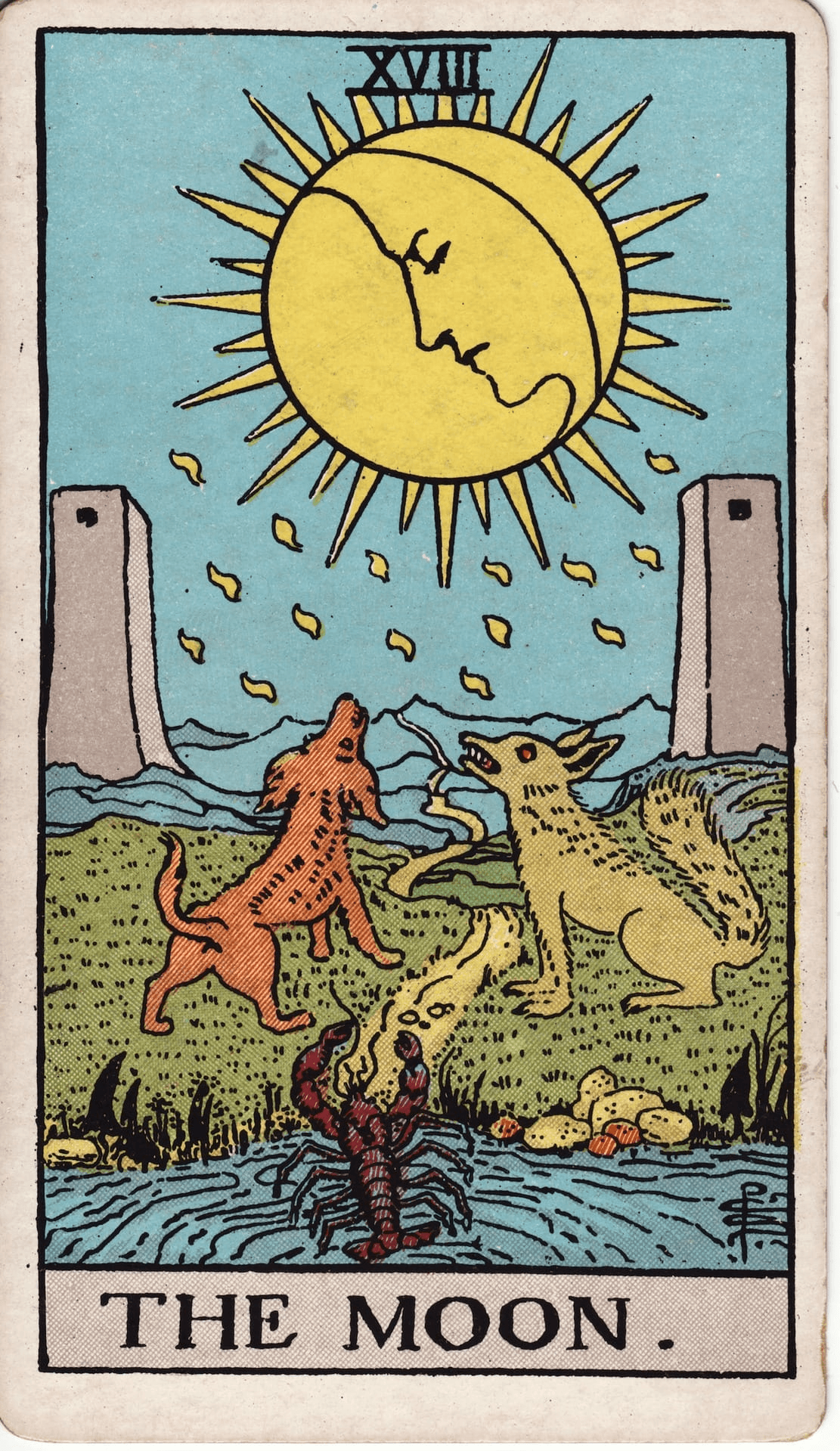
Rider–Waite–Smith examples for illustration. Explore full meanings in the directory.
Upright reading
You know the plans were cancelled. You do not yet know why. The Moon fits that uncertainty. Before deciding your friend has lost interest, ask a question they can answer: “Would you like to make a plan for next week, or is this a bad time?” Let the response add information instead of treating the cancellations as the whole story.
Reversed reading
You may be able to name the worry more clearly: “I am afraid they no longer want to see me.” Read the reversed Moon as an invitation to examine that worry. What supports it, and what have you assumed? Ask about the plan directly. If you have learned something new, use it; the reversal alone does not tell you why your friend cancelled.
What changed?
Upright, the reading starts with missing information. Reversed, it examines the worry filling that gap. Either way, the next step can be a direct question. Turning the card does not create a fact about your friend.
Knight of Pentacles: finishing a promised task
You promised to make a poster for your club meeting on Friday. You have a draft, but it is not ready to send.
Question: How do I finish the poster I promised our club?
Same question and advice position · Classic Rider–Waite–Smith cards

Rider–Waite–Smith examples for illustration. Explore full meanings in the directory.
Upright reading
The Knight’s horse stands still while he attends to the pentacle. As advice, this fits careful, ordinary work. List what remains: date, venue, readable text, and a final check. Finish one item at a time, then send the poster. You need a usable version for Friday rather than another burst of enthusiasm.
Reversed reading
Check whether your careful method has become the delay. If you keep changing the font while the venue is still missing, decide which details matter and stop revising the rest. Knight of Pentacles reversed can ask you to loosen an inflexible routine or find a smaller task you can begin. Set a time to finish the necessary checks.
What changed?
Upright, a clear routine helps complete the work. Reversed, you inspect the routine itself. The question is whether your method gets the poster finished or keeps you occupied without sending it.
Page of Cups: saying thank you to a friend
A friend called on Tuesday when you needed someone to talk to. You want to tell them you appreciated it, but you keep rewriting the message.
Question: How can I tell my friend that their help mattered?
Same question and advice position · Classic Rider–Waite–Smith cards
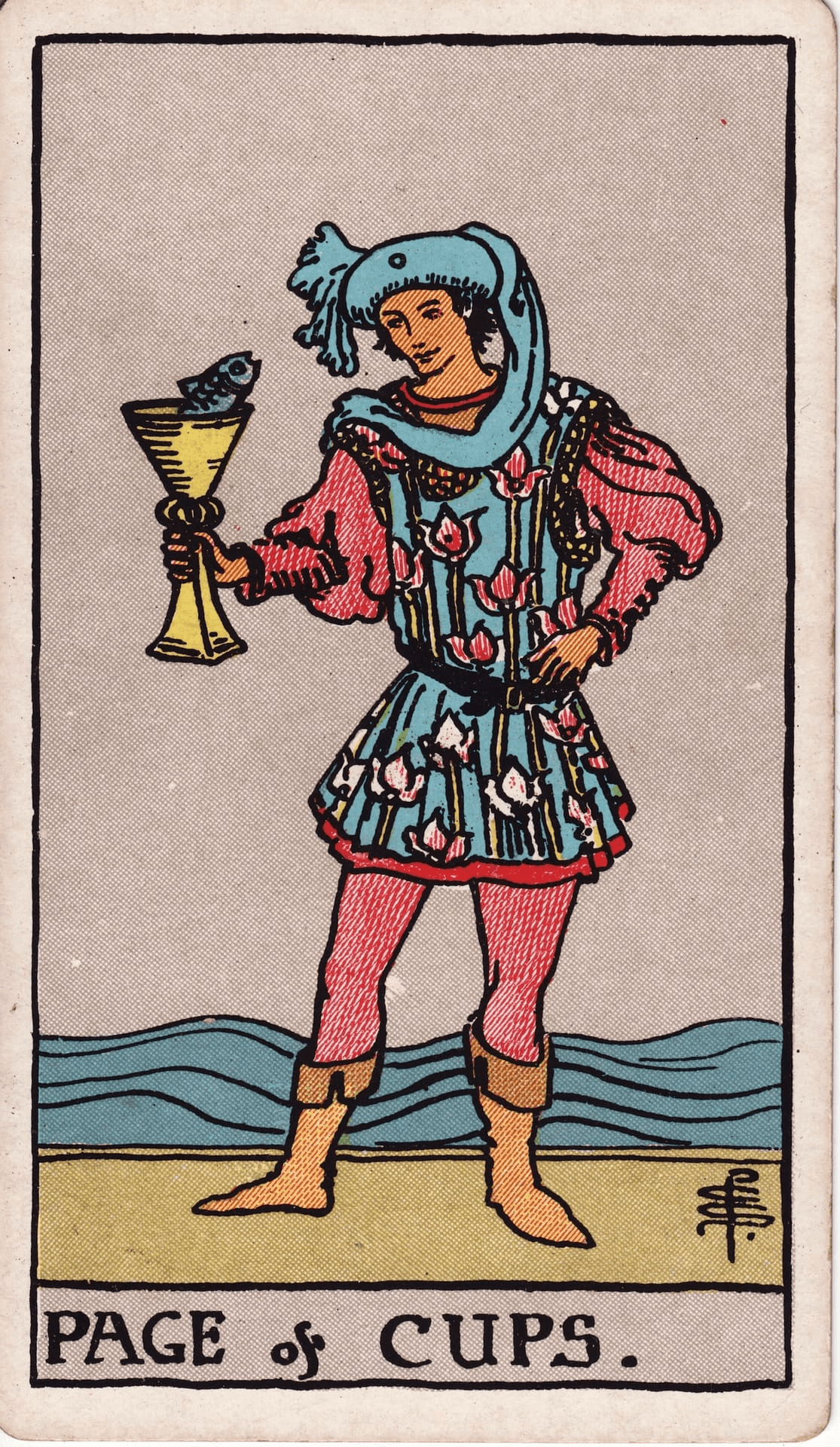
Rider–Waite–Smith examples for illustration. Explore full meanings in the directory.
Upright reading
Page of Cups suits a small, sincere emotional offer. Say what your friend did and why you appreciated it: “Thank you for calling on Tuesday. I was glad to have someone to talk to.” The message can be warm without trying to describe the whole friendship.
Reversed reading
Ask what makes the message hard to send. Are you embarrassed to say something personal, or hoping your friend will tell you how much you mean to them? Page of Cups reversed makes that hesitation or expectation worth checking. Return to the specific thank-you you wanted to give, and leave your friend room to respond in their own way.
What changed?
Upright, you say what you appreciated. Reversed, you examine the hesitation or expectation making that difficult. The card does not determine how your friend will receive the message.
Eight of Swords: speaking at a team meeting
You have a suggestion for next week’s team meeting, but you keep imagining that someone will dismiss it.
Question: What would help me speak at our team meeting?
Same question and advice position · Classic Rider–Waite–Smith cards
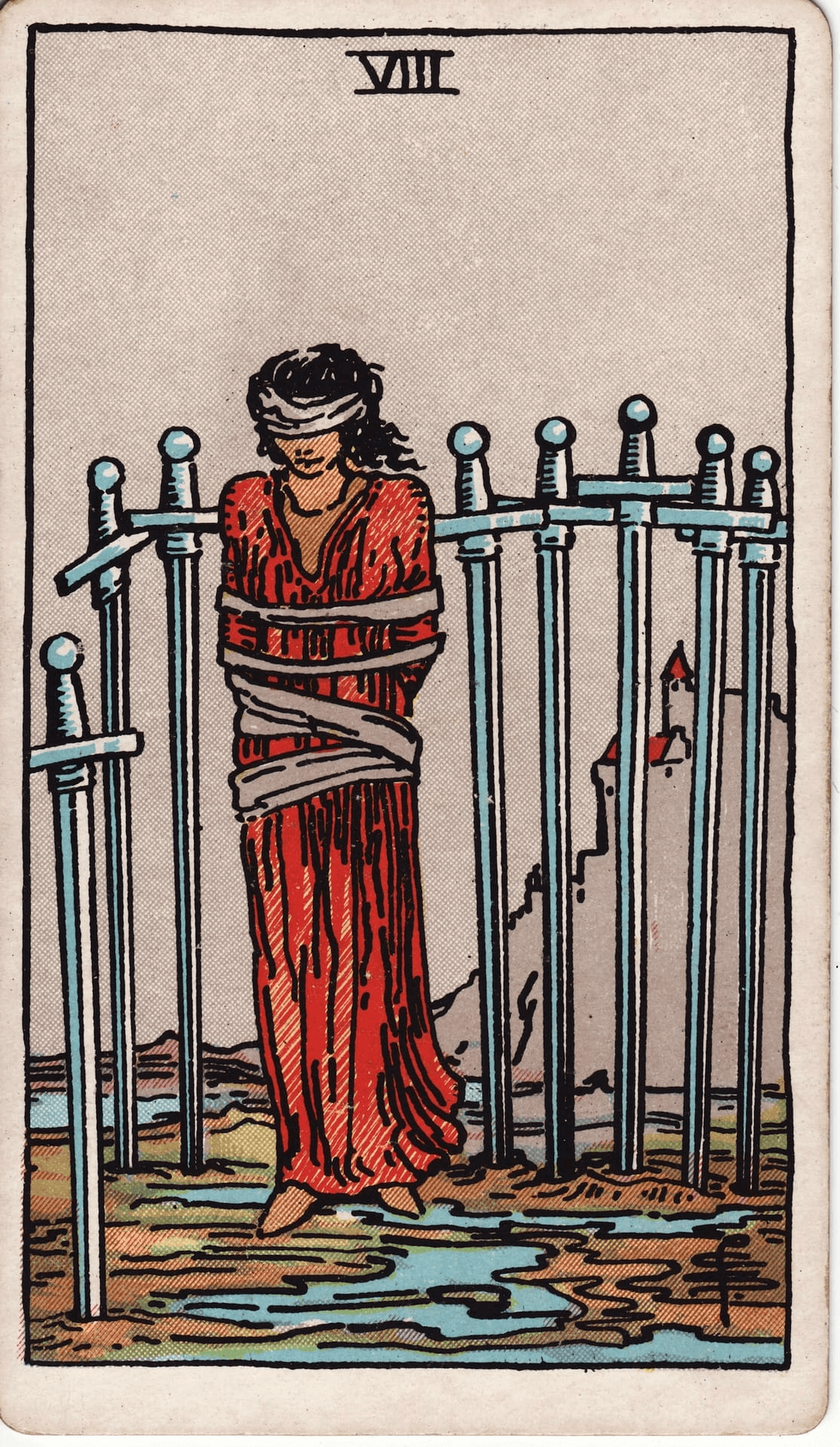
Rider–Waite–Smith examples for illustration. Explore full meanings in the directory.
Upright reading
The blindfolded figure stands among the swords. Read that image against the difficulty you know: you have an idea, but the imagined response is keeping you quiet. Separate a real constraint from an assumption. Do you need time on the agenda, or are you guessing nobody will listen? Write the suggestion in one sentence and find out how to put it forward.
Reversed reading
You may be beginning to see a way to contribute even though the worry remains. Eight of Swords reversed can focus on that opening. Choose the part you can do: prepare the sentence and ask for a moment to explain it. You do not need to feel completely confident before making a small contribution.
What changed?
Upright, you identify what makes the choice feel unavailable. Reversed, you examine a choice you may be becoming willing to use. The meeting can still have real limits; the card does not make them disappear.
If more than one reversed meaning fits
Write down the two possibilities and what supports each one. For example, a delayed reply might fit hesitation or an ordinary scheduling problem. Check the known circumstances before choosing. You can leave a question open until you have more information.
Use the same check when reading a pair. One reversed card changes its part of the reading; it does not erase the other card. Keep the roles you assigned and connect both meanings to the question. Two reversed cards still need two distinct contributions.
Try a short practice reading
Take one card and assign it as advice for an ordinary task: replying to a message, finishing a piece of work, or making a plan. Write one upright reading. Turn the card and write what you would reconsider. Check that the second reading changes something specific instead of simply declaring the first one wrong.
Try the practice readings with answer notes. To compare cards from your own spread, use the card combination lookup. Choose the orientations in “Read these cards for my question” before asking for a personal reading.
Try it on YouTarot
Get a reading tailored to your question
Tarot works best as reflection. Use our AI readings to explore what the cards might highlight for you right now—not as fixed predictions.